
Romania on the AI Value Chain: Advantages and Opportunities
Romania’s AI advantages lie at the two ends of the value chain: low-carbon power and a growing compute pipeline upstream, and strong IT-services capacity alongside the EU’s widest adoption gap downstream.
By George Ștefan · Consilium Policy Advisors Group

AI as a value chain
Romania’s advantages in artificial intelligence fit at the two ends of the value chain, not in its middle. The country is not likely to build frontier models for now. However, it holds low-carbon power and a growing compute pipeline upstream, the largest IT-services capacity in the region downstream, and the widest adoption gap in the European Union, which is also the largest unserved market. This note sets out a simple map of the sector, places Romanian firms and sectors on it, and draws three conclusions for companies that want to invest or find partners here.
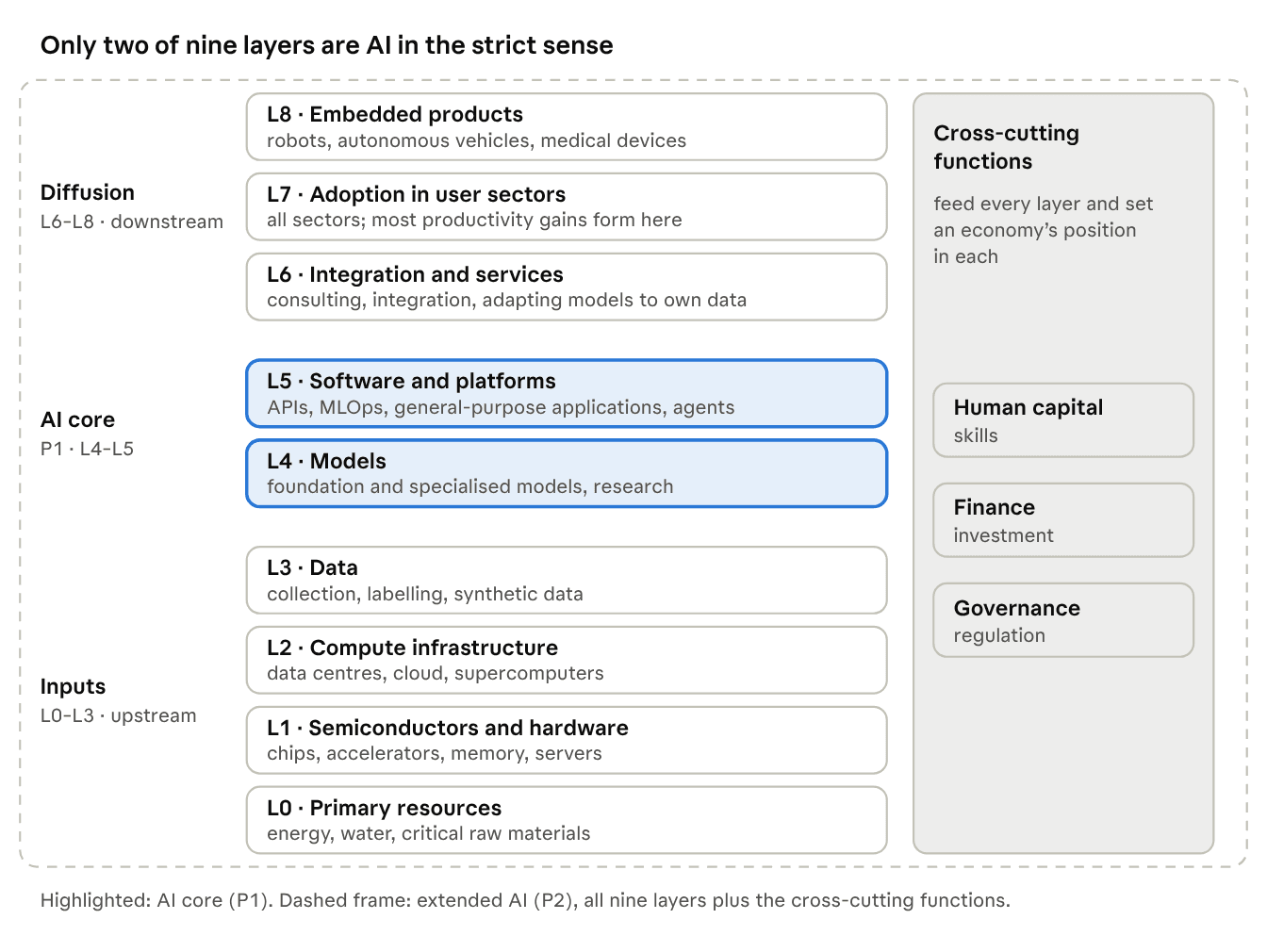
Official statistics have no activity code for artificial intelligence. AI can be imagined as a chain of nine extensive layers. Two of them are AI in the strict sense, namely models (L4) and software platforms (L5). This is the core, where the technology rent is captured and where global concentration is most pronounced.
Below the core sit four layers of inputs: primary resources such as energy, water and critical materials (L0), semiconductors and hardware (L1), compute infrastructure (L2) and data (L3).
Above it sit three layers of diffusion: integration and services (L6), adoption by firms in every sector of the economy (L7), and products with AI built in, such as robots, vehicles and medical devices (L8). Three functions cut across all nine layers and decide where an economy can stand on each: human capital, finance and governance.
Where Romania stands on the chain
The practical consequence is that most of the money, and nearly all of the macroeconomic effects, form outside the core. The geography of the chain is fairly stable. The core and the accelerators are generally from the US, fabrication equipment is European and Japanese, and advanced fabrication is East Asian. For a Central and Eastern European economy, the accessible segments are therefore at both ends of the chain, with a few well-defined niches in between.
Upstream, the advantage is power and compute. Electricity is the scarce input for data centres, and Romania can offer zero-carbon baseload from nuclear and hydro sources. Installed data-centre capacity is only 77 MW, yet announced projects exceed 1.8 GW, about 23 times the present base, led by an 800 MW development in Dolj. The Black Sea AI gigafactory concept earmarks 1,500 MW, anchored on Cernavodă units 3 and 4, and is a candidate in the EuroHPC gigafactory call, which mobilises €5 billion of EU funds and at least €20 billion of private capital, with selections expected in early 2027. In the semiconductors segment, the position is design rather than fabrication: Infineon employs more than 850 people in Romania, over 700 of them R&D engineers, and opened a fourth centre in Cluj in 2026. Data centres are a requirement for frontier AI, and capacity without a local talent pool and a start-up ecosystem risks becoming an ineffective asset.
In the core, the realistic play is vertical. The economics of the model layer are shifting: the share of notable new models released with open weights fell from 56% to 40% between 2020 and 2025, the cost of inference at a given quality fell from $20 to $0.07 per million tokens in two years, and fewer than 1% of AI start-ups outside the frontier economies build foundation models, while 72% build business applications on top of them. Margin is moving toward platforms and integration, which is where Romania’s core-layer firms already operate: UiPath in agentic automation (FY2026 revenue of $1.61 billion), Bitdefender in security (Romanian entity turnover of €360 million), DRUID AI in conversational agents (€27.5 million Series C, the country’s largest round of 2025) and Almetra in industrial AI (€16.65 million Series A in 2026). All four export.
Downstream, the advantage is integration capacity and an open market. IT services exports passed €10 billion in 2025, growing by 22%, and the ICT sector accounts for 7.1% of GDP. This is the layer that adapts models to a client’s own data. At the same time, only 5.2% of Romanian enterprises used AI in 2025, the lowest share in the EU, against an average of 20%. Across the Union, adoption runs at 17% among small firms, 30% among medium ones and 55% among large ones, so the gap is essentially a mid-market gap, the segment integrators serve. In embedded products, the first names have appeared: Dexory, based in London, in warehouse robotics ($165 million Series C in 2025), and BraveX and Qognifly Systems in drones.
Where firms can enter: sectors on the map
Each sector of the Romanian economy meets the chain at a different layer and through a different class of technology. The table summarises the entry points for six of them.
| Sector | Upstream entry | Core and downstream | Dominant technology | Evidence |
|---|---|---|---|---|
| ICT | Colocation, cloud, AI factories (RO AI Factory, H1 2027) | Vertical platforms; integration for all other sectors | Generation, workflow automation, agents | IT exports above €10bn |
| Healthcare | Clinical and imaging data | Diagnostics; devices and surgical robots | Perception, prediction | Regina Maria: AI diagnostics, 9 surgical robots |
| Aerospace and defence | Engineering and sensor data | Design and MRO engineering; drones and autonomous systems | Autonomy, perception | Airbus: 1,200 staff, AI engineering team |
| Energy | Zero-carbon power for data centres | Grid and asset management, predictive maintenance | Prediction, decision automation | Transelectrica €200m+ digitalisation; OMV Petrom machine learning for pumps |
| Automotive | Chip design (Infineon Cluj) | Factory automation; driver assistance and embedded AI | Autonomy, inspection | Infineon: 850+ staff |
| Financial services | Transaction data, under governance constraints | Adoption leader | Scoring and fraud detection, language | Highest expected gains in executive surveys |
Source: CPAG, November 2026
What decides the returns
Energy is the only sector present at both ends of the chain, as a supplier of power to compute infrastructure and as an adopter of predictive tools for its own assets. For a technology provider, the matching rule is simple: perception and autonomy solutions find their counterparts in healthcare, aerospace and automotive; prediction and decision automation in energy and finance; generative tools and agents in ICT and among integrators.
The evidence on returns is consistent across sources: experimentation does not pay; integration does. A World Bank survey of 1,516 Romanian firms finds a labour-productivity premium of about 0.4 log points only among the 6.1% of firms that embedded AI in a core business function; the 10.2% that use it at the margins show no premium. Adopters were already larger, better managed and more likely to export; 91% of them neither hired nor dismissed staff, and only 14% train their employees in AI. In advanced economies, a survey of nearly 9,000 executives reports a realised productivity effect of 0.5% over the past three years and an expected 1.7% over the next three, with no employment effect so far.
Two structural factors work in the region’s favour. Ageing raises demand for automation: IMF estimates associate a ten-point rise in the old-age dependency ratio with a 30% higher probability of adopting AI or automation. Capital is also rotating, with 52% of venture investment in Central and Eastern Europe going to AI in 2025, against 23% a year earlier.
However, there are also constraints. Skills are the binding one, and firm-level training remains rare. There is also the risk of rent leakage: when the use of AI grows faster than domestic production, part of the created value leaves the country as payments for cloud services, licences and intellectual property. Partnerships that build local production in platforms and integration are essential to retain a larger part of the value inside the country.
Three moves for firms and potential partners
1. Locate the firm on the map. A company should know its layer, its class of technology and its role, whether producer, user or enabler. Most Romanian firms are users first; the open question is where a production position is reachable, and the potential candidates are compute (L2), platforms (L5), integration (L6) and embedded products (L8).
2. Invest where the country has an edge. Upstream, this means power-backed compute and chip design. In the core, vertical platforms and specialised models. Downstream, integration for the unserved mid-market and embedded AI in automotive, aerospace, health devices and energy assets.
3. Underwrite the complements. Returns follow management quality, data and training, not the purchase of the technology. These should be budgeted inside the investment programme, and success measured by the intensity of use in core functions rather than by the fact of simple adoption.
Korea–Romania cooperation in practice
The Korea–Romania forum showed how the map works in practice. Korean firms are present on almost every layer, with particular strength in hardware and physical AI, while Romania offers engineering talent, integration capacity, low-carbon power and access to the EU single market. The two positions are complementary, and the map is best read as an effort to create a coordinated system for finding the right partner.
Sources
• Eurostat, use of artificial intelligence in enterprises (2025 data);
• World Bank, World Development Report 2026: The Promise of Artificial Intelligence;
• Cirera, Comin, Cruz and Lee, AI Adoption in Developing Countries, World Bank (2026);
• Yotzov et al., Firm Data on AI, NBER Working Paper 34836 (2026);
• Nguyen, IMF Working Paper 26/176 (2026);
• Dealroom, CEE Startups 2025 in Review;
• EuroHPC Joint Undertaking, AI gigafactories call (2026);
• Datacenter Forum and Tema Energy (October 2026);
• ANIS, BNR and INS (2025–2026); company reports and press (UiPath, Bitdefender, Infineon, Romania-Insider, Ziarul Financiar, The Recursive).