
Enlargement in an Age of Insecurity
Enlargement used to be a project of completing Europe; it is now a project of protecting it. Twenty years of data show the effort pays off — and today’s candidates start where Romania and Bulgaria stood in 2007.
By Ella Kállai and Laurian Lungu · Consilium Policy Advisors Group
Nam tua res agitur, paries cum proximus ardet.
When your neighbour’s wall is on fire, it is your business.— Horace
Horace wrote it two thousand years ago. For many EU member states, it has been a lived reality since February 2022. For Romania, that wall now runs along the Prut and the Danube.
This is why enlargement has changed its nature. In 2004, the Union enlarged because it believed history had ended. Today it enlarges because history has returned. Enlargement used to be a project of completing Europe; it is now a project of protecting it. It is not a favour the EU does its neighbours. It is how the Union keeps the fire from spreading.
The economics point the same way. Two decades of data on the countries that joined in 2004 and 2007 show that the effort of accession pays off. Today’s candidates start from roughly where Romania and Bulgaria stood when they joined.
The economics is smaller than the politics
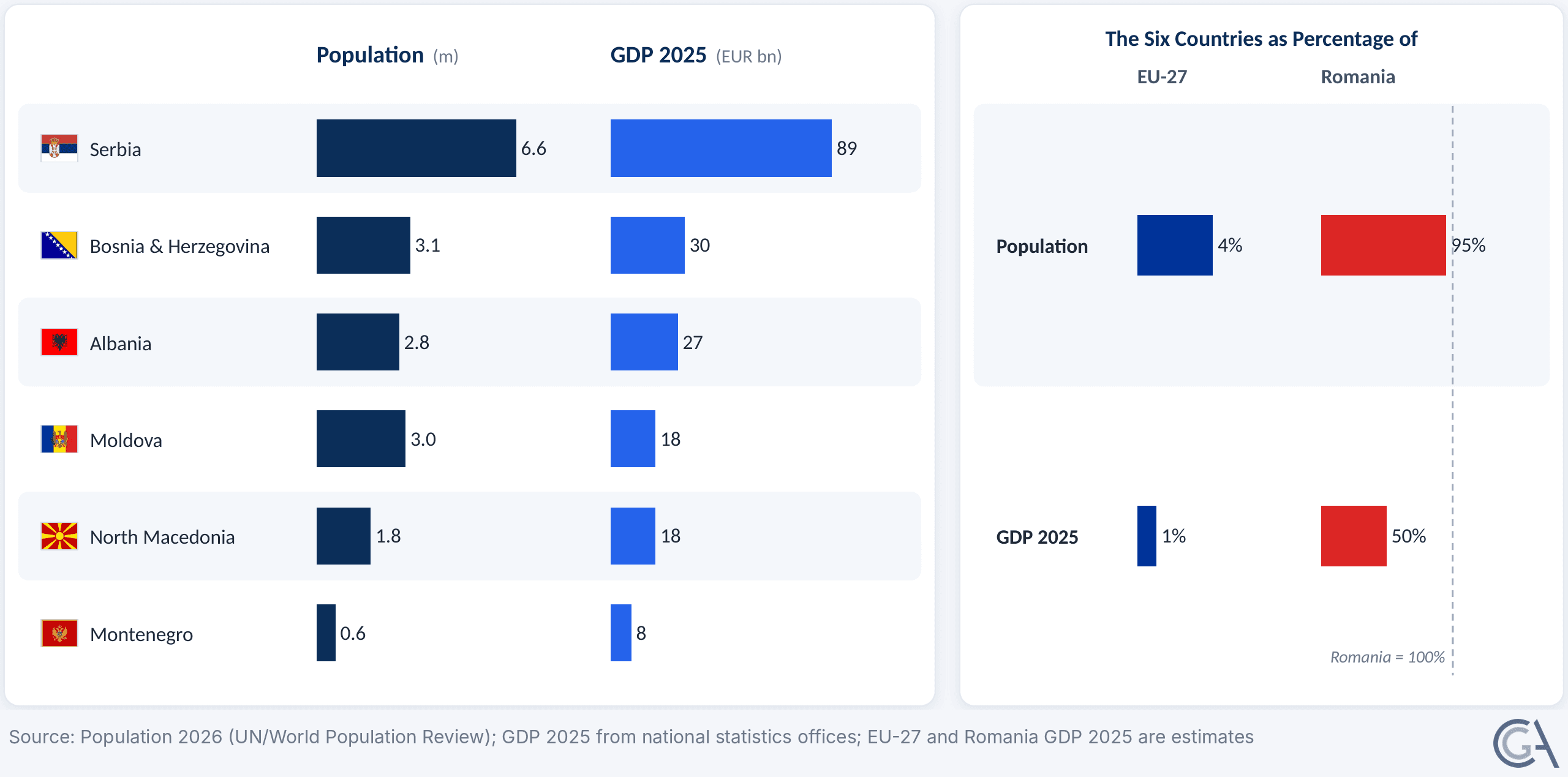
Six candidates — Serbia, Bosnia and Herzegovina, Albania, Moldova, North Macedonia and Montenegro — have about 18 million people and a combined GDP of around €190 billion: 4.0% of the EU-27 population and about 1.0% of its GDP. Ukraine is left aside here: it is a much larger economy and it is a different proposition. Turkey and Georgia are also excluded given that their accession negotiation processes are currently frozen.
Benchmarked against Romania, the six have a combined population about the same as Romania’s, but a combined GDP of only about 50% of Romania’s. From a purely economic point of view, absorbing them would not be a major effort for the Union. Their economic weight is small; their strategic weight is large.
Why this wave is different
In 2007, the logic was economic convergence. New members adopted the acquis, opened their markets, received cohesion funds and gradually caught up. Security was provided elsewhere, by NATO, and Russia was still treated as a partner rather than a threat. That world is gone. Three things set the current wave apart.
1. The EU is enlarging toward conflict zones. No previous candidate brought an active front line or occupied territory into the accession process, nor faced the same hybrid pressure. Moldova lives with Transnistria for instance. Ukraine instead is in much more difficult position.
2. The single market has become a security instrument. Electricity grids synchronised with Europe, defence-industrial supply chains and shared standards for critical infrastructure are not only economic gains; they are resilience. Every interconnector is a strategic asset as much as a commercial one. This is also why integration is becoming gradual: candidates enter parts of the single market before full membership, so that membership confirms a reality rather than creating one overnight.
3. The challenge is uneven. For the Union as a whole, the accession of the smaller candidates would barely register. Ukraine is different: a large agricultural producer with reconstruction needs measured in hundreds of billions, whose membership would reshape the Common Agricultural Policy, cohesion funding and voting weights in the Council all at once.
Enlargement is therefore two debates in one. For most of the queue, the question is political will. For Ukraine, it is also whether the Union is ready to change its own budget and its own rules.
Twenty years of catching up
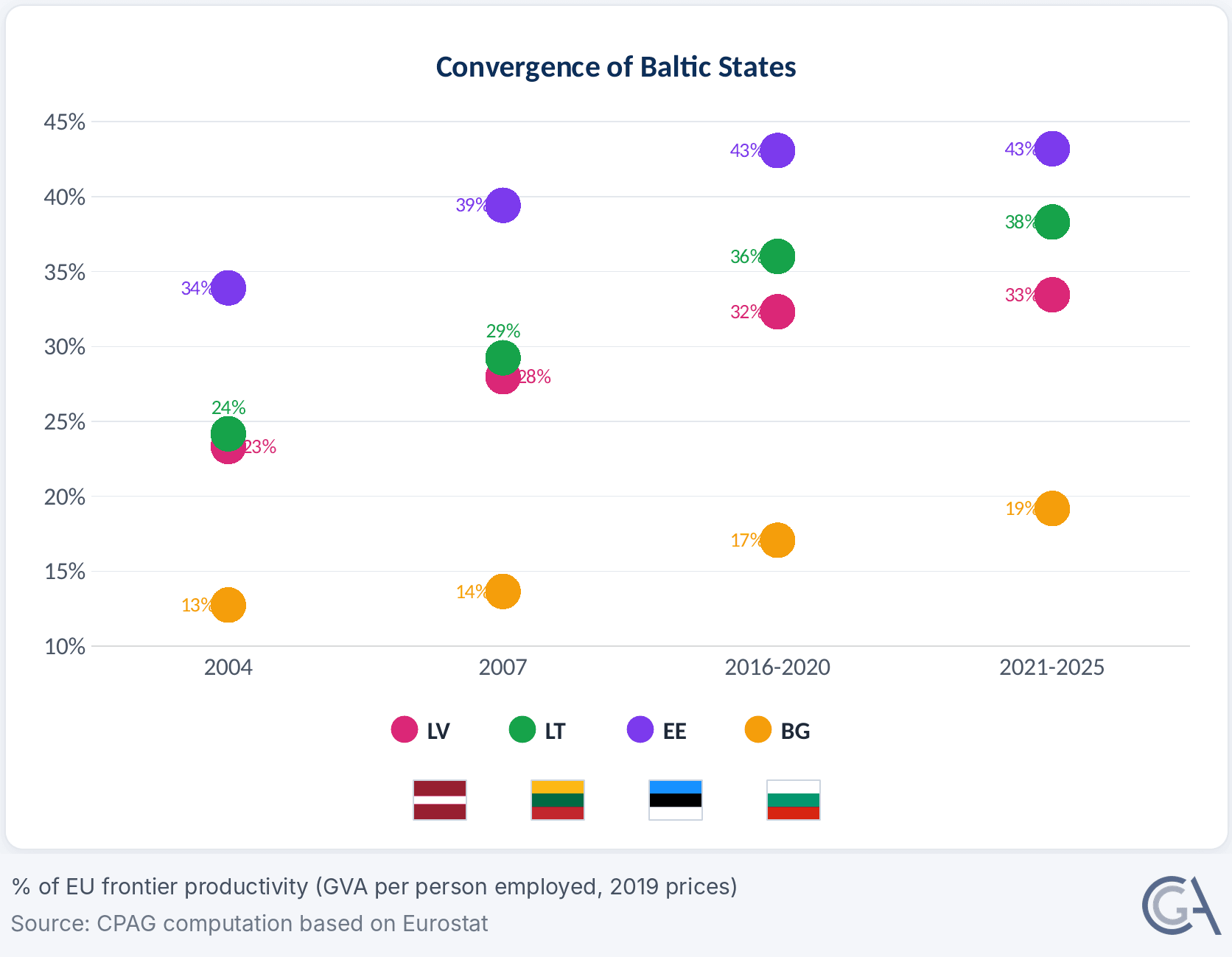
Every country that joined the EU in 2004 and 2007 has narrowed its productivity gap with the EU frontier, defined as the average of the three best performers: Denmark, Sweden and Belgium. Productivity is measured as gross value added per person employed, in 2019 prices. The gaps between countries were large in 2004 and remain large today, but all of them moved closer to the frontier.
The pace differed. Among countries with their own monetary policy, catching up was fastest where the starting gap was largest: Romania gained almost 12 percentage points and Poland about 10. Czechia, the closest to the frontier in 2004, gained close to 9 points. Hungary, with the second-best starting point, gained under 4. The Baltic states, with currency boards or fixed exchange rates and euro adoption in 2011 (Estonia), 2014 (Latvia) and 2015 (Lithuania), also accelerated, by 9 to 14 points. Bulgaria, on a currency board since 1997 and in the euro area since 2026, gained about 6 points from the lowest starting point. Where the gap narrowed to about half, as in Czechia and Estonia, convergence stalled.
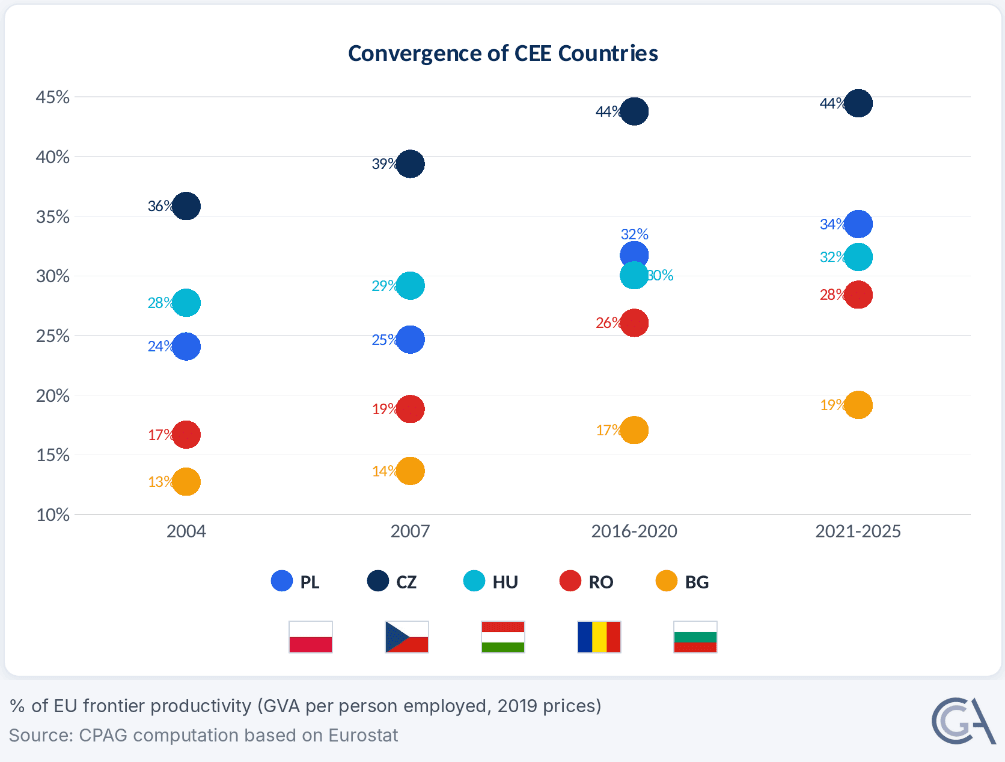
The ranking barely changed. Only Poland overtook Hungary, in the last decade. Hungary is a useful lesson for the candidates: its path drifted away from European values, especially on the rule of law. The Commission froze EU funds earmarked for Hungary, and part of them were lost for good. Without EU funds, convergence slows.
Where the candidates stand
The Western Balkan candidates now stand roughly where Romania and Bulgaria stood when they joined. In 2021–2025, their productivity averaged 15.9% of the EU frontier, between Bulgaria’s 13.6% and Romania’s 18.8% in 2007.
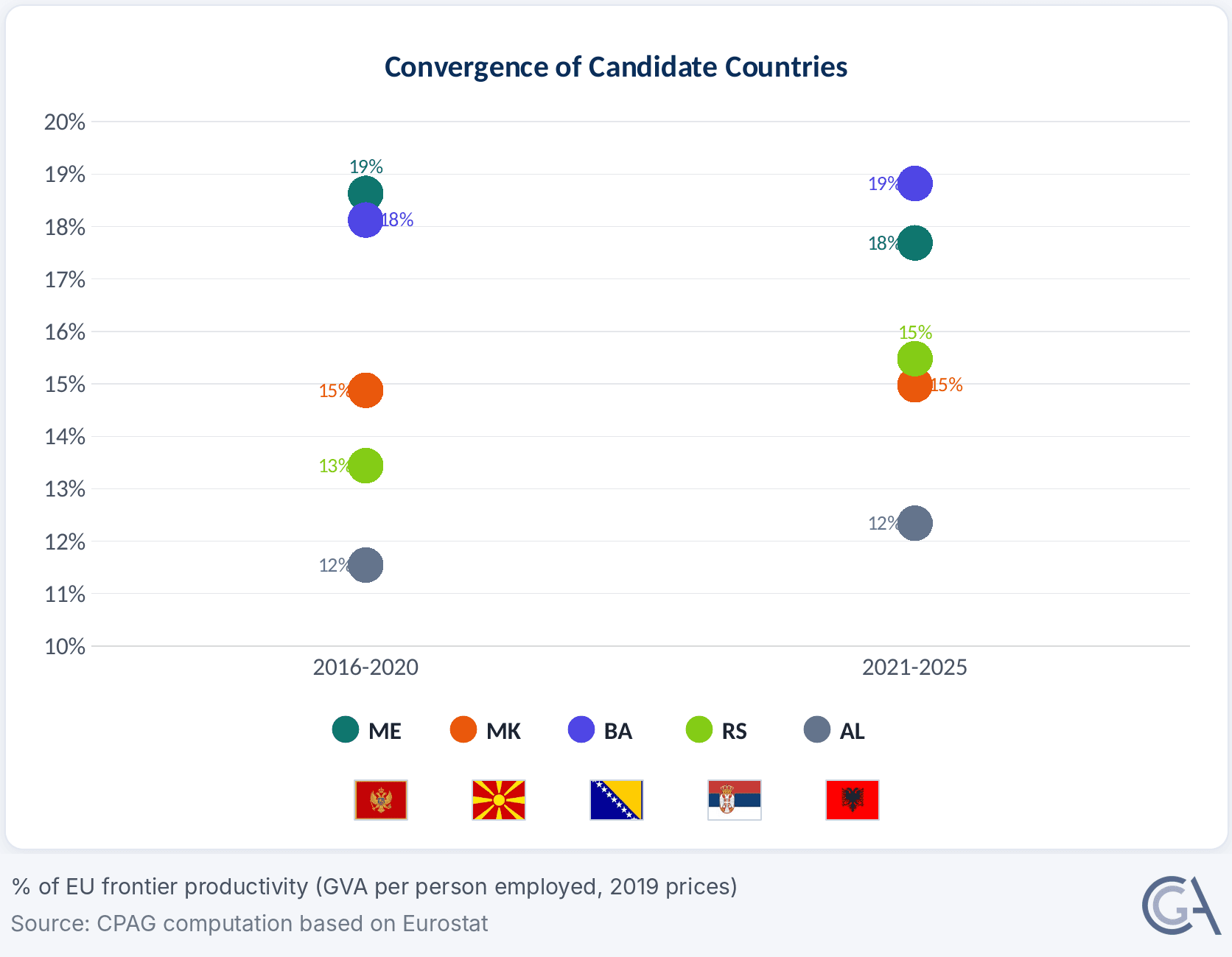
Compared with 2016–2020, Serbia gained 2 percentage points and Albania almost 1. Elsewhere the gap was broadly unchanged, ranging from a 0.9-point loss in Montenegro to a 0.7-point gain in Bosnia and Herzegovina. Serbia and Albania are the only candidates with an independent monetary policy. Montenegro has used the euro since 2002. North Macedonia pegged its currency to the Deutsche Mark in 1995 and to the euro in 2002. Bosnia and Herzegovina has run a currency board since 1997.
The experience of the earlier members suggests that accession can bring accelerated catching up. If that experience repeats over the next 20 years, the outlook for the candidates is bright, whatever their monetary regime. Those with currency boards or pegs to the euro might even join the euro area earlier than the others. The conditions are clear: join the EU, keep good relations with neighbours, and stay on the European path consistently, without deviating as Hungary did.
Three risks
• Unanimity. Every accession treaty requires the agreement of every member state and ratification in every capital. With many other elections across Europe next year, the political risk remains.
• Timing. There is haste on one side and delay on the other. The temptation to close chapters before the political window shuts is real, and the urgency is understandable. But reforms rushed today become backlash tomorrow. Judicial independence and the fight against corruption cannot be fast-tracked. Delay, in turn, costs credibility. Western Balkan countries applied fifteen to twenty years ago; if they watch others overtake them, the EU could lose ground in Belgrade, Sarajevo and Podgorica, and others might fill that vacuum.
• Capacity. A union of 30-plus members that still decides foreign policy by unanimity, and has not settled how the next budget treats agriculture and cohesion, could become more paralysed. Wider without deeper is sprawl, not strength. Internal reform is not an excuse to delay enlargement; it is what makes enlargement work.
Size, however, is not an obstacle. Montenegro, for instance, a country of just over 600,000 people, has become the front-runner of this enlargement wave. It is also holding the right debates before joining, learning from the experience of those who joined earlier. A small state with clear political will can move faster than larger ones.
What candidates can learn from Romania’s experience
Romania knows what accession demands because it lived it, imperfections included: years under the Cooperation and Verification Mechanism and a long wait for Schengen. It also knows the frontier: it shares a border with Ukraine and a language with Moldova. And it has seen what membership can deliver. Measured in purchasing power, GDP per capita has risen from about a third of the EU average in 2004 to almost four-fifths today. This is the strongest argument Romania can offer the candidates, and the strongest answer to sceptics who doubt that enlargement works.
Romania’s experience also yields concrete lessons.
1. Put the rule of law first, and early. Weak rule of law and corruption can hold a country back more than a lack of infrastructure. Institutions are better built early than late, because without them even a European path can drift.
2. Build the right fiscal institutions. Romania went through a fiscal roller coaster, from very large deficits down to smaller ones under EU- and IMF-supported programmes. When wages grow faster than productivity, political pressure for higher pensions or infrastructure spending beyond what EU funds cover can push public finances off a sustainable path. Deficits and debt must be kept consistent and sustainable.
3. Find niches and attract FDI. The candidates are small economies. They need national champions able to compete in the single market, niches in European supply chains and foreign direct investment, the channel through which capital and technology arrive. Even Romania still needs a lot of FDI.
4. Keep the legal and tax system stable. Taxes changed overnight, as has happened in Romania, scare investors away. Any investor wants to invest in a stable country.
Romania can therefore speak credibly to both sides. To the candidates: reform is hard, do not cut corners, it is worth it. To sceptical capitals: the cost of leaving the neighbourhood in limbo is paid first on our border, and eventually on yours.
Enlarge in stages, and relatively soon
The EU should accept new members relatively soon, before enlargement fatigue sets in. A staged enlargement would help. The benefits of membership would then arrive as each country advances with its reforms, not only at the end, as in previous waves. Candidates could show their citizens tangible gains from Europe before full membership, and a process slowed down by unanimity would be less exposed to fatigue. Enlargement is also good for Europe itself: to compete with the United States and China, the Union needs a clear strategy, and new members would bring competitive advantages to the bloc as a whole.
Concordia parvae res crescunt, discordia maximae dilabuntur.
Through concord small things grow; through discord even the greatest fall apart.— Sallust
The European Union is proof of the first half of the above sentence: it began as a community of six and grew into a union of 27. Enlargement now tests whether it can avoid the second half.
That requires agreement in every capital, patience in every candidate and trust across every border. Horace reminded us that a fire next door is our business; Sallust, that we can only put it out together. Europe must build an enlargement process strong enough to survive an election in Paris, and serious enough to deserve the trust of Chișinău, Kyiv, Podgorica or Tirana.